Human Wisdom for the Age of AI Faculty Guide
Lesson 6: Communications
Time required: 45-60 minutes
This lesson teaches students that effective communication requires a human’s understanding of the situation and audience, their ability to decide what is appropriate and persuasive and their ability to influence through emotion and character.
Learning Objectives - help students to
- Analyze the difference between "informative text" (AI) and "persuasive communication” (human)
- Evaluate their writing for the three rhetorical appeals: logos, pathos and ethos
- Strengthen their ability to connect with an audience by injecting personal voice and storytelling into technical work
Materials
- Student devices with access to a GenAI tool
- Persuasion Triangle worksheet
 The Storyteller
Develop your unique human capability to influence others and inspire positive action
AI is an automated text generator. Humans are storytellers. In a world filled with AI-generated content, the most valuable currency is effective communication. The ability to make people feel connected to information, to build trust and rapport, is your human competitive advantage.
Helping students develop the skills of "The Storyteller" begins with motivating them to move beyond simple data transfer. It requires mastering the ancient art of rhetoric — balancing logic with emotion and credibility to move an audience to action.
Aristotle
384 - 322 BC
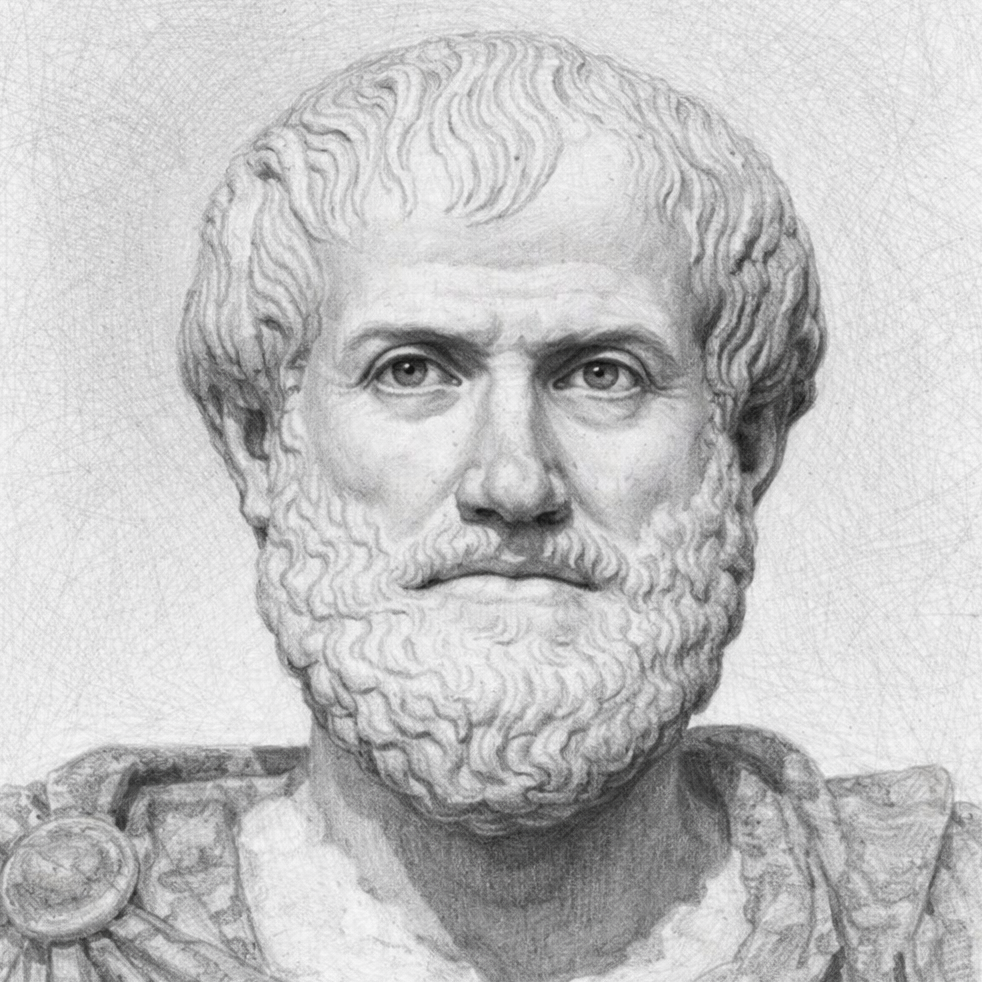
Greek philosopher and polymath, student of Plato, tutor to Alexander the Great, foundational to Western thought
“The proofs furnished by the speech are of three kinds. The first depends upon the moral character of the speaker. The second upon putting the hearer into a certain frame of mind. The third upon the speech itself, in so far as it proves or seems to prove.”
From: ”Rhetoric” Book I, Chapter 2
Written: Approx. 367-347 BC
- Aristotle defines the art of rhetoric as the ability to persuade audiences through three pillars, ethos (credibility), pathos (emotion) and logos (logical argument).
- AI generates language, but it does not persuade in the human sense. It has no skin in the game. It simulates connection, but it cannot forge the shared human bonds that build cities or movements. That power remains ours.
Engage the Class
Start the conversation: "If you received two emails asking for a favor—one written formally and flawlessly by AI, and one written casually and personally by a friend—which one would you say 'yes' to? Why?”
Let's go: “Today, we are going to learn how to take the ‘perfect’ text AI gives us and add the human elements that drive influence: emotion and character.”
Exercise
The Persuasion Triangle

Introduction (5 minutes)
Explain the Triangle: A strong argument needs all three sides. AI can provide you with some facts or ideas, but you must decide if they are appropriate or persuasive (logic). You must build the other two (emotion and character).
The AI Draft (10 minutes)
Have students prompt an AI to write a short persuasive argument on a topic they care about. Ask: "Read it. Is it logical? Is it boring? Does it sound like you?"
The Human Edit (20 minutes)
Ask students to rewrite the draft using the triangle:
- Keep the logos: Use the AI's best facts.
- Add pathos (emotion): Add a specific personal story or a vivid metaphor.
- Add ethos (character): Rewrite the opening to sound like their voice. Remove the generic "AI words."
The Comparison (10 minutes)
Have students swap papers with a partner. Ask the partner: "Which part of this feels real? Which part feels like a machine?"
The Persuasion Triangle: Audit
Topic:
LOGOS (The Head)
What are the key facts/arguments provided by the AI?
PATHOS (The Heart)
The AI text is likely cold. Write one new sentence here that uses a specific emotion, story, or sensory detail to make the reader FEEL the issue on an emotional level.
My Addition:
ETHOS (The Gut)
The AI text has no reputation. How will you establish YOUR credibility?
My Voice:
SYNTHESIS
Combine the three elements into a final "Opening Hook" for your argument:
Question 1
Aristotle argues that effective persuasion depends on three elements—ethos (credibility), pathos (emotional appeal), and logos (logical argument). Do you think one of these is more important than the others in modern communication (e.g., politics, advertising, social media, journalism)? Why?
Question 2
Look at the ”pathos" you added in the exercise. Why is it so hard for an AI to generate a genuine personal story? Why do we trust a story with "flaws" more than a perfect, generic paragraph?
Question 3
"Ethos" is about character. If you use AI to write an email to a professor or boss without checking it, what does that say about your character? Does it signal competence or laziness?
Question 4
In the future, ”logos" (data/facts) will be cheap and instant. Do you think ”pathos" (connection) will become more valuable because it is rare, or less valuable because we are used to talking to bots?
Question 5
Can you think of a leader or speaker you admire? Do they speak like an AI (perfect grammar, neutral tone)? Or do they have a specific, unique style? How can you develop a style that is "AI-proof"?
Reflective Assessment
How well did this lesson enable students to:
- Distinguish between logical text and persuasive human communication?
- Identify the "emotional gaps" in an AIgenerated draft?
- Rewrite generic content to include personal voice and story?
How can you build on this module to help students find their own voice?
Adapted from the Student Guide to Artificial Intelligence (2026), developed by Elon University’s Imagining the Digital Future Center in partnership with American Association of Colleges and Universities. Used with permission under the Creative Commons BY-NC-SA license.
Have a Question?
Take a look at frequently asked questions about AI at NIU and available resources.