Yakubu Naporo
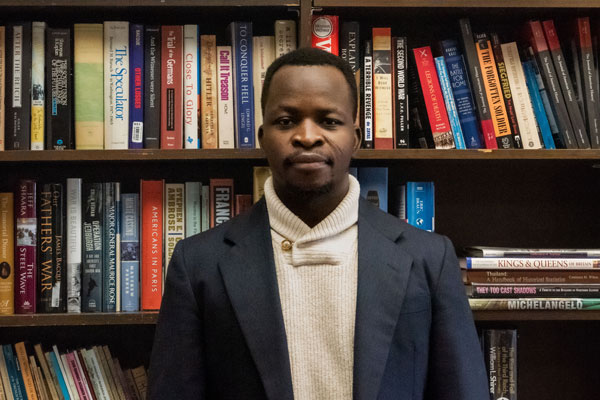
Yakubu Naporo is a history doctoral student from Kanvilli, Tamale, Ghana
Hometown: Kanvilli, Tamale, Ghana
High School: Savelugu Senior High School (SAVESS)
Year: Expected graduation: Spring 2029
What scholarships did you receive and why did you receive them? How has the financial support impacted your experience at NIU?
I was awarded a graduate assistantship, which has been a cornerstone of my academic pursuits at NIU. This assistantship not only covers my tuition but also provides me with a stipend that allows me to fully immerse myself in my studies and research without going to bed on an empty stomach. Quite apart from this, I have also benefited significantly from numerous scholarships and grants, from the departmental level to the college level, which I used to support my research travel. Some of the scholarships I got in summer 2025 were the Raymond and Kathleen Kengott Distinguished Scholarship in International Service and the Alfred F. Young (Hayter-Young) Research Fellowship. These scholarships were very instrumental as they supported my pre-doctoral archival research travel to the New York Academy of Medicine to conduct research on British West Africa. I received other grants that I used for my conference travel. All these scholarships and grants have enabled me to dedicate more time to my academic pursuits and professional development.
What did you want to be when you were growing up? Are you pursuing that as a major, or have you taken another path?
Growing up in a small community in Northern Ghana, my dream was to become a medical practitioner. This was born out of my experience with my dad’s indigenous medical profession. My father was a Dagbandoo, a role synonymous with that of an indigenous healer. The medical practice of my father drew on indigenous knowledge systems, and he dedicated his life to serving the health needs of our community and distant villages through referrals as a result of the efficacy of his medications. I witnessed his daily interactions with his patients at a young age, and I became increasingly fascinated by the intricate relationship between health and societal progress. It was this experience with my dad’s practice that planted the seed for my dream to become a medical practitioner. However, as I grew up and equally made progress through my education, my path took an unexpected yet enriching turn toward the study of history, particularly the history of medicine. Now, as a medical history student, I find myself exposed to how different people from diverse cultural backgrounds across nations and empires developed responses and strategies to their political economies and health challenges. While I may not be pursuing a medical degree, I believe my specialization in the history of medicine resonates with my enduring interest in the mainstream medical field. It may be a different path, but it’s one that still honors the essence of my initial dream: to contribute to the field of medicine, albeit through a historical lens.
What is your graduate program and why did you decide on this course of study?
I am pursuing a Ph.D. in history with a specialization in the history of medicine. Like the Cuban revolutionary leader Fidel Castro, I believe “history will absolve me,” and that is why I chose to study the discipline and equally specialize in medical history. My research spans the intricate narratives of infectious disease governance, colonial and postcolonial public health, and the intersections of environment and diseases. I am interested in how the British imperial medical regime in the 19th and 20th centuries shaped health policies and medical practices in British West Africa. Ultimately and through my research, my goal is to inform health policymaking and contribute to the existing body of knowledge in the field of medical history.
Tell us about the research you are doing at NIU and why it interests you.
My current research project investigates the entanglements of global health governance, neoliberal political economies and capitalists’ humanitarianism in Africa. The decades between 1980 and early 2000s marked a period when infectious disease control in Africa was deeply entangled with neoliberal reforms and the growing influence of corporate and pharmaceutical entrepreneurs competing for health interventions in Africa. Within this period, health itself became increasingly commodified and corporatized as public institutions gave way to privatized and market-oriented systems. The argument I am advancing is that such interventions should not be viewed as an isolated response to diseases but as part of a longue durée of colonial, imperial and capitalist genealogy of health governance in Africa. From colonial medicine to civilizing missions and post-Cold War philanthropy’s technocratic logics, health interventions have consistently been tied to systems of governance and political economy. As such, capitalist humanitarianism represents both continuity with these earlier traditions and a distinct reconfiguration under neoliberalism. This is part of my broader project and it aims to rethink the history of global health and humanitarianism not as a story of benevolence but as one of shifting entanglements between care, capital and power.
How has conducting research strengthened your education and experience at NIU?
Research has been one of the most rewarding parts of my experience at NIU. It has allowed me to apply what I learn in the classroom to raise critical historical questions and at the same time find missing links and/or silences with my archives. More than anything, my research has transformed my education from simply studying history to contributing to it.
How will your research experience help you in the future?
My research experience at NIU has prepared me to think critically, work independently and contribute meaningfully to global conversations about health, environment and history. After all, the utilitarian function of the historian is to educate and inform.
Who at NIU has been important to your success doing research and why?
Professor Beatrix Hoffman (retired) has been one of the most important influences on my success as a researcher at NIU. Her research in the history of medicine, especially the necropolitics and politics of public health, healthcare reforms and social movements in the U.S., deeply shaped the way I think about my own work. During my master’s program in the history department, she taught me the nitty-gritty of conducting and analyzing archival sources and encouraged me to connect historical research with contemporary public health issues. She was so helpful to me, I must say.
What advice would you give to an incoming student as it relates to research at NIU?
I know at the Ph.D. level expectations and responsibilities are high, but it’s doable so long as you put your mind into it. Be curious, ask questions, attend workshops and take advantage of the library and research resources on campus. One thing you also need to pay attention to as a student is the need to normalize the research struggle. Because it’s not always easy.
What has been something you have found pleasantly surprising about your experience at NIU?
One of the most pleasantly surprising aspects of my experience at NIU has been the incredible support and resources available for personal and academic growth. From my first day on campus, I was greeted with a lot of opportunities to engage in research, join student organizations and connect with professors. There is also a strong sense of belonging and community beyond this environment for academic growth. And I think it’s good to be part of a university where every individual’s potential is nurtured and where diversity of thought and background is celebrated as a strength.
How have you connected with other students to study for classes, meet new people or form new friendships?
Connecting with other students at NIU has been very helpful and has enriched my college experience. I have had the opportunity to attend classes with a mix of both undergraduate and graduate students. This experience has been incredibly rewarding, as it has allowed me to gain diverse perspectives and insights through classroom discussions and by learning about individual research projects. Additionally, attending the History Graduate Student Association (HGSA) annual conference and joining clubs like the Phi Beta Delta has been instrumental to me in meeting new friends. I met most like-minded people this way at NIU.
Are you involved in any student organizations, mentoring programs or extra-curricular activities? If so, which ones? How have they added to your experience as a Huskie?
From being a member to vice president and now the president of the History Graduate Students Association (HGSA), I collaborate with fellow history graduate students in organizing annual conferences, where students and scholars come together to discuss historical research across different fields and timeframes, share insights and engage in meaningful conversations. I have been a graduate student judge for the Conference on Undergraduate Research and Engagement (CURE), where I provided useful and constructive feedback to undergraduate students on their research to help them improve their skills as researchers. This fall, I had the opportunity to be trained as a research mentor by the Office of Student Engagement and Experiential Learning and the Graduate School at NIU. This training will equip me with the skills needed to mentor and support students as they develop their research and community engagement skills. Additionally, I volunteered as station-archivist at Northern Public Radio (WNIJ) in DeKalb. I was responsible for preserving the station’s memorabilia and making thank-you calls to donors. I believe these experiences have not only augmented my academic journey but have also provided me with invaluable skills needed for my professional development.
What NIU offices, departments or resources have helped you feel safe, supported and successful? And how?
I have found tremendous support through the Department of History, which provided me with mentorship, academic guidance and a strong sense of community. International Student and Scholar Services (ISSS) has also been very instrumental in helping me navigate life as an international graduate student with the dos and don’ts and general immigration advice. Also, I used to be afraid of the police even when I was a child. But as they say, “the police are your friend,” and I now understand that at NIU the police are supportive and committed to keeping students safe, which has helped me feel more secure in my daily activities on campus. These offices, along with the larger NIU graduate community, have created an environment where I feel safe, supported and able to succeed.
Who has been one of your favorite instructors/professors and why? What course did they teach?
Wow! This has been the hardest question for me so far. It is hard to choose just one professor because I have been inspired by and fortunate to learn from so many faculty in the history department. Each of them has shaped my perspective in different ways, especially through their teaching and research guidance. That notwithstanding, Professor Ismael Montana stands out as one of my favorite professors, and he serves as my academic advisor as well. I first took his African diaspora course, which challenged me to think critically about the theories and debates about the African diaspora, including the global histories of movement and other topics related to the African diaspora. Later on, I had the opportunity to serve as his teaching assistant, which allowed me to learn novel pedagogies from him in the classroom. His guidance as my advisor has invaluably shaped my academics.
How have you benefited by attending class regularly?
Regular attendance has kept me accountable and deeply connected to my academics. It allows me to stay fully engaged with course materials, contribute meaningfully to discussions and build strong relationships with professors and classmates. I have found that some of my best ideas and research directions have come from peer reviews and discussions that happened in the classroom. These are important things I would have missed had I not been there.
Where is your favorite spot on campus or in the community? Why are you drawn to it?
My favorite spot on campus is the Founders Memorial Library. I am drawn to it because it offers both quiet spaces for deep focus and resources that fuel my research as an early-career researcher. I often spend long hours there working through my sources, writing or preparing for class.
What advice would you give to a student who is researching colleges to apply to?
My advice to a student researching colleges is to look beyond just the programs on college websites and ask yourself: Where will I feel supported and able to excel or grow holistically? I know academics are important to you but consider the community around you as well. Reach out to faculty, talk to current students and explore the resources that are available to students like yourself. Look for mentorship programs, cultural resource centers and opportunities for leadership and involvement to develop yourself academically, socially and personally. For me, NIU offered all of these resources.
Why is a college education important to you?
A college education is important to me because it has given me the confidence to pursue and compete for opportunities I never imagined and it continues to shape the person and scholar I am becoming. It has transformed both my life and my perspective.
What strategies do you use to manage your time between the responsibilities of school, work, friends and family?
I balance school, work, friends and family by being disciplined and staying dedicated to my time. I set reminders, use calendars and to-do lists to prioritize what needs to be done each passing day. I also set aside time for rest and connection because I have learned that balance is just as important as productivity. While unexpected things happen, I always try to stay flexible to accommodate such circumstances. Regardless, by keeping a routine and clear priorities, I’m able to manage my school responsibilities and also make time for the people and activities that keep me grounded.
How do you stay informed about events and services that are available on campus?
I stay informed about events and services on campus by regularly checking my NIU email for the Weekly Scroll of Things to Know and also staying connected with student organizations like the History Graduate Student Association. Word of mouth is also another way I stay informed. Conversations with classmates, faculty and staff often point me toward opportunities I might have missed otherwise.
What do you do to relax or recharge?
I enjoy playing soccer with friends and watching the English Premier League and UEFA Champions League. I’m a die-hard fan of Liverpool FC, so following their games and rooting for them at the same time is one of my favorite ways to unwind. I also go to the gym at the NIU Recreation Center to keep fit. These activities give me balance, help me stay connected to what I love and allow me to return to my studies with fresh energy.
Please tell us about your job and hobbies.
I work as a graduate teaching assistant in the history department, where I support classes and help guide students in their learning. I sometimes utilize the opportunities from my supervisors/professors to conduct guest lectures. I also play and watch soccer.
Explore More @ NIU
Academics
Follow @HuskiesofNIU on Instagram and see the university through the eyes a different Huskie each week