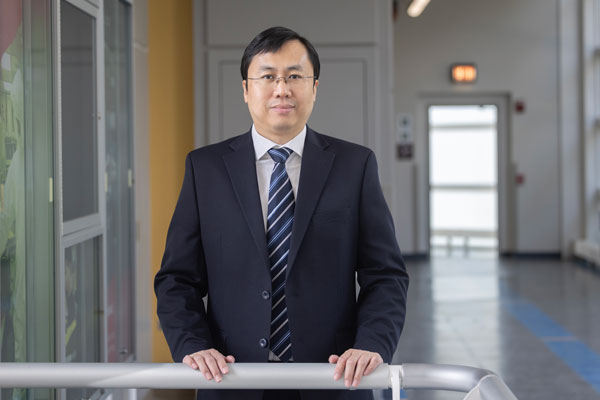
Bo Zhang
Assistant Professor, Department of Mechanical Engineering, College of Engineering and Engineering Technology
What year did you start working at NIU?
2024
Where is your hometown, and where do you live now?
I grew up in Shijiazhuang, Hebei Province, China. Today, I live in Aurora, Illinois, and commute to Northern Illinois University, where I serve as an assistant professor of mechanical engineering.
Where did you attend college and what degree(s) have you earned?
I earned a B.S. in environmental engineering and an M.S. in applied chemistry from Yanshan University in China. I later completed an M.A. in physics and a Ph.D. in mechanical engineering at Baylor University in Texas. This interdisciplinary educational journey has given me a broad foundation spanning engineering, physics, chemistry and applied mathematics, which continues to shape my research in computational engineering, fluid dynamics, heat transfer and artificial intelligence.
Walk us through how your role connects to the student experience at NIU.
As a faculty member in mechanical engineering, my role is closely connected to the student experience through teaching, research and mentoring. In the classroom, I strive to create an environment where students develop not only technical knowledge but also critical thinking and problem-solving skills. I enjoy helping students understand the fundamental principles behind engineering and encouraging them to apply those concepts to real-world challenges. Beyond the classroom, I involve students in research projects in computational engineering, fluid dynamics and artificial intelligence. These experiences allow them to work with advanced computational tools, tackle open-ended engineering problems and gain hands-on research experience that prepares them for graduate study or careers in industry. I also see mentoring as an important part of my role. Whether discussing coursework, research opportunities or career goals, I enjoy working with students individually and helping them build the confidence and skills they need to succeed. My goal is for every student to leave NIU not only with strong technical abilities but also with the curiosity and lifelong learning mindset needed to thrive in a rapidly evolving engineering profession.
What do you love about working at NIU?
I enjoy the collaborative and supportive environment at NIU, which enables me to pursue innovative research while working closely with outstanding students. NIU encourages interdisciplinary collaboration, allowing me to develop AI-enabled computational methods for fluid dynamics, heat transfer and other complex engineering problems. The most rewarding part of my job is mentoring undergraduate and graduate students, watching them grow as researchers, and helping them develop the skills and confidence to tackle important scientific and engineering challenges.
Did you always plan to pursue a career in academia? What shaped your path to where you are today?
Yes. I have always been drawn to academia because it offers the unique opportunity to create new knowledge while inspiring the next generation of engineers and scientists. Throughout my education and research career, I became increasingly interested in using mathematics, physics, artificial intelligence and computational engineering to solve complex real-world problems. As a faculty member at NIU, I am able to pursue that vision through innovative research while mentoring students and helping them develop the skills and confidence to make meaningful contributions to science and engineering.
How do you see NIU's mission reflected in your day-to-day work?
I see NIU's mission reflected in my daily interactions with students. Whether I'm teaching in the classroom, mentoring undergraduate and graduate researchers, or collaborating with colleagues, my goal is to help students discover their potential and prepare them for successful careers. By engaging students in innovative research and encouraging curiosity, critical thinking and collaboration, I hope to contribute to NIU's commitment to student success, research excellence and service to our communities.
What keeps you motivated and energized in your work at NIU?
What keeps me energized is the opportunity to build a research program while working closely with students. I enjoy introducing students to research, helping them develop problem-solving skills and seeing their confidence grow as they tackle challenging engineering problems. I'm also excited by the opportunity to explore new ideas in computational engineering and artificial intelligence. The combination of discovery, teaching and mentorship makes every day at NIU rewarding.
What's one thing about NIU that has surprised you?
One thing that has pleasantly surprised me is how supportive and collaborative the NIU community is. From my colleagues in the Department of Mechanical Engineering and across the College of Engineering and Engineering Technology to the students, everyone has been welcoming and willing to help. That collaborative environment makes it much easier to pursue new research ideas and create meaningful learning experiences for students.
How do you see NIU's commitment to access and affordability reflected in the students you teach and the opportunities available to them?
One of the things I appreciate most about NIU is that it provides opportunities for students from a wide range of backgrounds to pursue a high-quality engineering education. In my classes and research, I see students who are motivated to learn and eager to take on new challenges when given the right support and encouragement. NIU's commitment to access and affordability helps make those opportunities possible, and I strive to contribute by creating an inclusive learning environment where every student has the chance to develop the knowledge, confidence and research skills needed for a successful career.
Tell us about a research or engaged learning project you have led and how it has shaped the students involved.
One of my favorite engaged learning projects is a Computational Heat Transfer and Fluid Mechanics course project in which students develop a shock-capturing method for compressible flows. Rather than simply using existing software, students build and test key components of the numerical algorithm themselves, gaining a deeper understanding of how computational methods are designed and implemented. Throughout the project, they learn to analyze results, troubleshoot numerical challenges and connect mathematical theory with real engineering applications. By the end of the course, many students have a new appreciation for how advanced engineering software is developed and greater confidence in tackling complex computational problems.
What do you enjoy most about mentoring students?
What I enjoy most about mentoring students is helping them discover their potential. I enjoy watching students grow, from learning the fundamentals to confidently tackling complex engineering problems on their own. Whether in the classroom, through course projects or in research, I encourage students to ask questions, think critically and embrace challenges as opportunities to learn. Seeing students gain confidence, develop as independent thinkers and achieve their goals is the most rewarding part of being a faculty member.
What career paths have you seen your students pursue after NIU, and what do you think prepared them most for that success?
As a relatively new faculty member at NIU, I'm excited to help prepare students for a wide range of career paths, including graduate school, industry and national laboratories. I believe what prepares students most for success is not only a strong technical foundation but also hands-on experience solving open-ended engineering problems. Through projects and research, I encourage students to develop critical-thinking, programming, communication and teamwork skills. Those experiences help them become adaptable, confident engineers who are well prepared for whatever career path they choose.
What do you hope students take away from their time in your classroom and at NIU?
I hope students leave my classroom with more than just technical knowledge. I want them to develop the confidence to tackle challenging problems, the curiosity to keep learning and the resilience to overcome setbacks. Engineering is about solving real-world problems, so I encourage students to think critically, ask questions and approach challenges with creativity and persistence. I also hope their time at NIU helps them become lifelong learners, effective collaborators and professionals who use their skills to make a positive impact on society.
What advice would you give to students currently attending NIU?
My advice is to be curious, take on challenges and make the most of every opportunity. Don't be afraid to step outside your comfort zone by joining research projects, internships, student organizations or competitions. Those experiences often teach lessons that go beyond the classroom. At the same time, build strong relationships with your professors and classmates. They can become valuable mentors, collaborators and lifelong friends. Finally, remember that learning is a journey. Stay persistent, embrace setbacks as opportunities to grow and never stop asking questions.
Who has been the most influential person in your professional journey, and how have they shaped your approach to your work?
I have been fortunate to learn from many outstanding mentors throughout my academic journey, each of whom influenced me in different ways. They taught me the importance of pursuing meaningful, fundamental research while maintaining the highest standards of scientific rigor. They encouraged me to ask ambitious questions, think independently and persist through challenges rather than choosing only the easiest problems to solve.
Their guidance has shaped my approach as both a researcher and an educator. My research spans computational fluid dynamics, artificial intelligence and scientific computing, with applications ranging from cardiovascular flow and nanoscale heat transfer to shock-wave capturing and multiphase flows. Although these applications are diverse, they are united by a common goal: developing new computational methods that help us better understand complex physical systems. In the classroom, I encourage students to be curious, think critically and understand the principles behind engineering tools instead of simply applying them. I hope to pass on the same encouragement and confidence that my mentors gave me throughout my career.
Beyond the classroom, how are you engaged in your profession and your community, and how does that work inform what you bring to NIU?
Beyond the classroom, I stay engaged with the broader engineering research community by collaborating with researchers at universities, national laboratories and industry partners, publishing research, reviewing manuscripts and participating in professional conferences. These activities allow me to stay current with emerging advances in computational engineering, scientific computing and artificial intelligence while building collaborations that create new opportunities for research and student involvement. Within the NIU community, I enjoy mentoring students, participating in departmental service and working with colleagues to strengthen our research environment. These experiences help me bring current research challenges, real-world engineering applications and professional perspectives into the classroom. My goal is to provide students with not only a strong technical foundation but also an understanding of how engineering research can address important problems in society and prepare them for successful careers.