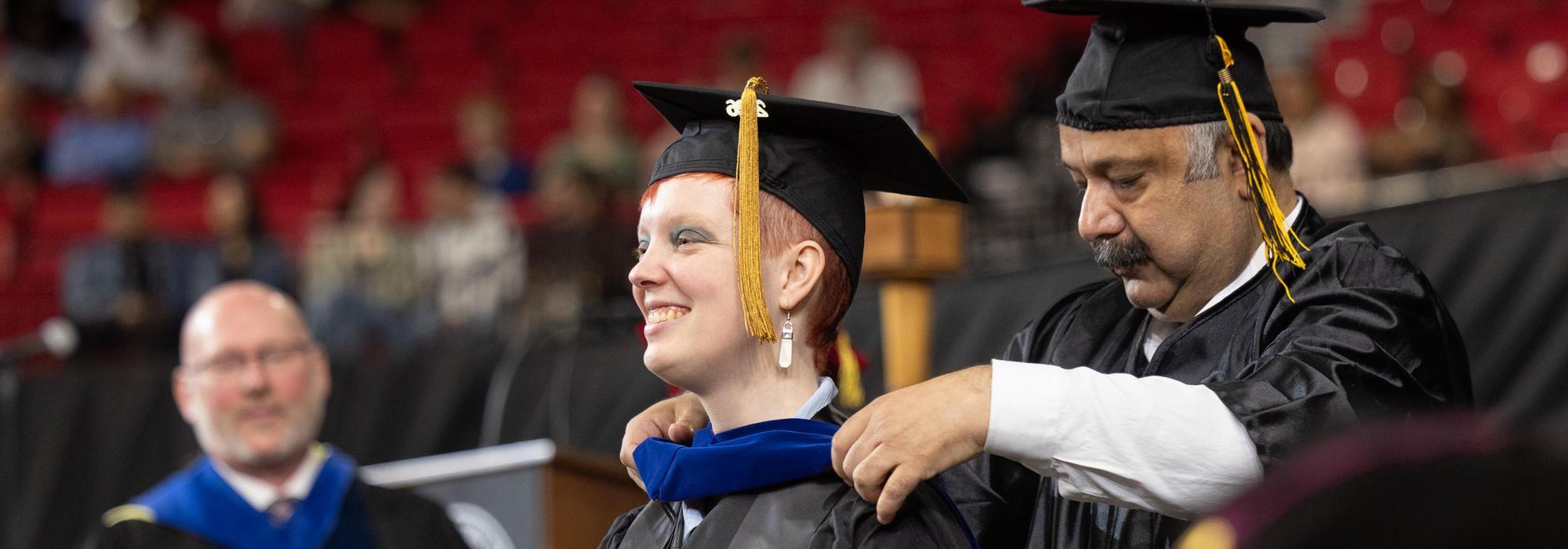
Ph.D. in Physics
The Ph.D. in physics at Northern Illinois University prepares students for careers in research, higher education, national laboratories and industry. Students develop a broad foundation in advanced physics while pursuing specialized coursework and original research in their area of interest.
The program offers opportunities to work with faculty on research connected to nearby national laboratories, including Argonne National Laboratory and Fermilab. Evening courses are offered in some semesters to accommodate nontraditional and part-time students.
At a Glance
- Degree: Doctor of Philosophy in Physics
- Credit hours: Minimum of 90 semester hours
- Location: DeKalb
- Format: Full-time and part-time options available
- Transfer credit: Up to 30 semester hours may be transferred from prior graduate study
Research Opportunities
Ph.D. students conduct original research with faculty in a range of physics disciplines. Research opportunities include work in condensed matter physics, elementary particles and fields, accelerator physics and physics education research, as well as interdisciplinary research connected to nearby national laboratories.
Explore physics research areas and to find potential research mentors and learn more about the department's research programs.
Students interested in computational physics and particle physics may also participate in the NIU–UIC Graduate Traineeship Program, a collaborative program with Argonne National Laboratory and Fermilab that provides specialized training, research experiences and financial support.
Admissions
Students interested in pursuing graduate study in physics should submit their application through the Graduate School. Applicants should review the university's graduate admission requirements and submit all required materials by the appropriate deadline.
Applications are accepted for fall and spring admission. International applicants have application deadlines of May 1 for fall admission and Oct. 1 for spring admission. To be considered for a teaching assistantship, applicants should submit their application by Feb. 1 for fall admission or Aug. 15 for spring admission.
Students interested in research assistantship opportunities are encouraged to contact potential faculty mentors after admission. Questions about the physics graduate program can be directed to the director of graduate studies.
Degree Requirements
The Ph.D. in physics requires a minimum of 90 semester hours of graduate study. Students complete 15 hours of core coursework by selecting five of six courses covering classical mechanics, quantum mechanics, statistical physics and electromagnetic theory. Students also complete 12 hours of 600- or 700-level coursework in two different areas of physics. Remaining hours may include dissertation research and other graduate coursework in physics or related fields.
Students entering with a master's degree or graduate coursework from another institution may transfer up to 30 semester hours toward the degree, subject to program requirements.
Students entering without a master's degree in physics must also pass the M.S. qualifying examination, typically during their first year. Students who have completed a master's degree in physics are not required to take this examination.
All Ph.D. students must successfully complete the Ph.D. candidacy examination, which assesses advanced undergraduate and graduate-level knowledge in classical mechanics, quantum mechanics and electricity and magnetism. The candidacy examination is typically completed after the core coursework and M.S. qualifying examination.
Students complete their program with original dissertation research and an oral defense. View the full Ph.D. in physics degree requirements in the Graduate Catalog.
Related Links
Apply for Admission
Explore Campus