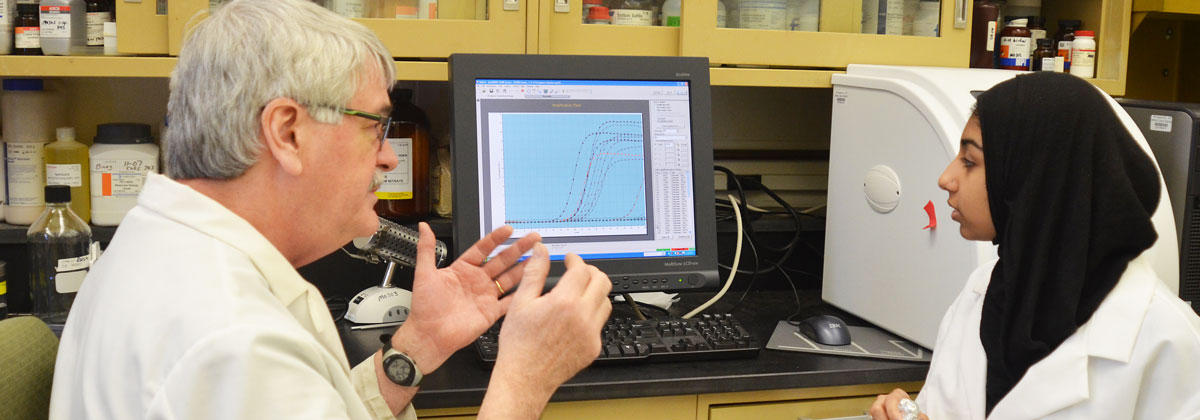
Molecular Core Lab
The main focus of the Molecular Core Lab is support for purification of DNA and RNA and the use of molecular biology equipment for analysis of gene expression and genotyping. Professor Grayburn has been working in labs with nucleic acids since 1981 and can help students with many aspects of molecular biology.
Gene expression studies frequently use quantitative real-time PCR (qPCR). This procedure has been used to determine if specific genes are expressed at different levels in response to growth conditions or stage of developmental. It can also be used to investigate how a gene deletion affects the expression of other genes. Many studies in different organisms are possible with this technology.
Capabilities and Equipment
The Molecular Core Lab uses capillary electrophoresis for DNA genotyping analysis. It is possible to distinguish individual plants, snakes, or other creatures from each other. In this assay, PCR products are labeled with fluorescent dyes that can be detected using a Beckman Coulter CEQ 8000 Genetic analysis system.
Major equipment includes:
- Centrifuges
- Thermal cyclers
- Lyophilizers
- Autoclaves
- Ovens
- Gel documentation systems
- Agilent Mx3000P qPCR instrument
- Beckman Coulter CEQ 8000 Genetic Analysis System
Undergraduate Research Opportunities
Undergraduate students work directly in the lab on active research projects. One area focuses on renewable biofuel production from algal cellulose, a glucose polymer that forms much of the structural framework of algal cell walls and is resistant to breakdown. Current work examines gene expression in a locally isolated bacterium involved in cellulose degradation.
Another research area investigates viruses that infect freshwater algae. Although viruses are the most abundant biological entities on Earth, most remain unstudied. Many virus sequences differ substantially from those in public databases, complicating identification. The lab uses an established model system to develop methods for enriching algae viruses from regional water sources.
Technical Notes and Protocols
SYBR Green qPCR assays require careful primer design to prevent non-specific amplification and primer-dimer formation.
- Design amplicons between 60 and 300 base pairs. Avoid regions with strong secondary structure or long nucleotide repeats. Avoid a 3' terminal T when possible.
- Target an annealing temperature near 60 C. A melting temperature near 65 C is typically sufficient.
- Screen primers for dimers and hairpins before synthesis.
- For cDNA analysis, design primers within the same exon and treat RNA with DNase before reverse transcription.
- Run BLAST searches to confirm specificity.
- Always include positive and negative controls when validating primer sets.
A method for isolating DNA fragments from agarose gels without commercial kits.
- Prepare fresh TAE buffer and cast a thin agarose gel.
- Excise the band of interest and place in a 1.5 mL tube.
- Freeze at -80 C.
- Thaw and centrifuge at maximum speed for six minutes.
- Recover the supernatant and repeat freeze and spin.
- Precipitate DNA using sodium acetate and ethanol.
- Wash with 70% ethanol, dry and resuspend in water.
Selected publications include work in microbial genomics, fungal biology, metabolic engineering, biofuel production and molecular genetics. Research has appeared in journals such as Mycologia, Molecular Microbiology, Applied and Environmental Microbiology, Proceedings of the National Academy of Sciences, Biotechnology Letters and Bioresource Technology.
For a complete and updated publication list, please contact Professor Grayburn directly.
External DNA Analysis Resources
Lab Contact
Scott Grayburnsgrayburn@niu.edu
815-753-0638
Office: Montgomery Hall 344
Lab: Montgomery Hall 303
Contact Us
Department of Biological SciencesMontgomery Hall 349
815-753-1753
815-753-0461 (fax)
General questions can be directed to kmeyer5@niu.edu.
Student enrollment questions can be directed to sfarley@niu.edu.