Master of Arts in Anthropology

Pursue advanced research of human behavior, culture, evolution and social structure.

Our M.A. degree program offers courses and research opportunities in all four subfields of anthropology: archaeology, biological, cultural and linguistic. You’ll be prepared to teach, conduct research in anthropology, practice in applied anthropology and/or continue on to doctoral study.

You can also pursue our interdisciplinary graduate certificate in museum studies.


Apply for Admission
Explore Campus

At a Glance


30-36 credit hours


In person


Full time


Start in the fall or spring semester


Career Outlook for M.A. in Anthropology Graduates

Average mid-career salary for alumni:

Top job titles for alumni:

Top employers for alumni:

Source: Steppingblocks, {{steppingBlocksSourceYear}}


How to Apply

You can apply if you have a bachelor’s degree in anthropology or a related field. You’re expected to have at least 15 undergraduate credit hours in anthropology. If you don’t, you’ll need to complete compensatory work during your graduate program.

Before applying, we recommend that you identify and contact a faculty member you’d be interested in working with during your program. View a list of faculty currently accepting students.

You’ll apply through the Graduate School.

We accept applications during the three application periods defined below:

Application Period To Start In Funding Options Decision Period
Dec. 1 – Feb. 1 Fall Graduate assistantships and tuition waivers March
Feb. 2- Apr. 30 Fall None May
May 2 – Nov. 1 Spring None December

Application Materials

Your application materials will include:

  • Two letters of recommendation from individuals who have a professional or academic relationship with you, are familiar with the demands of a graduate program and can speak to your ability to succeed in such a program. Discuss with them in advance whether you’ll waive or retain your right to read the letter.
  • Personal statement (750-1000 words) that outlines your preparation for graduate study, your goals for graduate school and beyond, and why our program can help you meet your goals. If applying to the thesis track, explain how your research interests overlap with those of a faculty member (or members) who might potentially serve as your thesis advisor(s).
  • Resume/CV in PDF format indicating relevant educational, professional and/or or volunteer experience.

Costs and Funding

Our competitive tuition and fees helps ensure an excellent return on the investment of your time and resources. Learn about additional funding opportunities for graduate students.

If you’re interested in studying topics related to Southeast Asia, you may wish to apply for a Foreign Language and Area Studies Graduate Fellowship.

Assistantships

We offer teaching assistantships that include a partial tuition waiver and a weekly stipend. We offer research assistantships depending on funding availability. Please contact the faculty member you’re interested in working with about the possibility of obtaining a research assistantship.

To apply, fill out a graduate assistantship application (PDF) and send it to April Law at aphelps@niu.edu before Feb. 1 to be considered for the next academic year. You should check that you’re interested in both a fall and spring assistantship. We do not offer summer assistantships.

Curriculum and Requirements

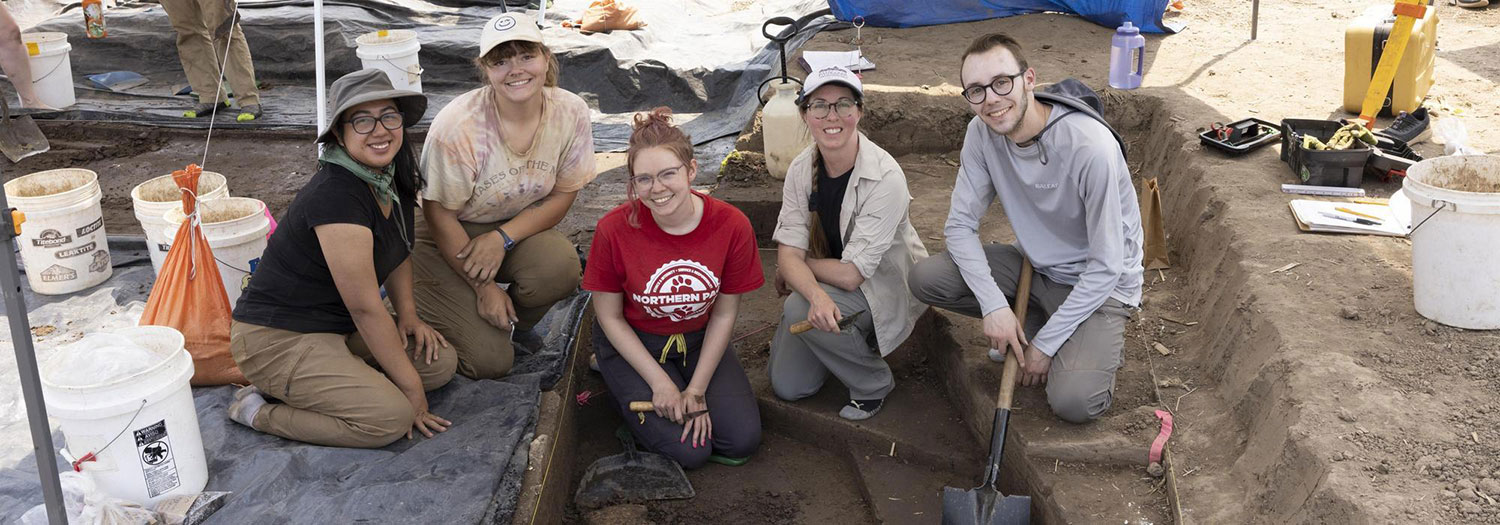
You may choose either a coursework-based curriculum ending with comprehensive exams in the four subfields (archaeology, biological, cultural and linguistic) or a more focused track with research experience leading to a thesis.

View Degree Requirements


Faculty

Our faculty bring diverse experiences and scholarship from the subfields of anthropology, including specializations in primatology, paleoethnobotany, social movements and many other areas. They’re committed to providing learning and research opportunities that prepare students for career success.

More About Our Faculty

Faculty Accepting Graduate Students

Name Specialty
Dana Carlsen Archaeology: paleoethnobotany, ancient foodways, discipline sociopolitics and gender equity. Dr. Carlsen will be on sabbatical 2026-27 and will not be accepting students for fall 2026 or spring 2027.
Giovanni Bennardo Linguistic anthropology (code-switching, conversation analysis, linguistic ideology;
Cognitive anthropology (cultural models).
Mitchell Irwin Primatology/primate ecology, with emphasis on diet, nutrition and movement. Dr. Irwin's advisees typically conduct fieldwork in Madagascar and/or nutritional ecology lab work on the NIU campus. However, pursuing other field sites or research with captive primate populations is also possible.
Emily McKee Cultural anthropology: environment and political ecology, nationalism, farming and regional food systems, water, environmental justice, Middle East, United States
Micah Morton Cultural anthropology: transnationalism, state-minority relations, social movements, religion and politics, spiritual ecology, ethnicity and nationalism and global Indigeneities in and beyond Southeast Asia and Southwest China
Leila Porter Primate behavior/primate ecology, with emphasis on social behavior, reproduction and parental care.
Mark Schuller Cultural anthropology, with emphasis on NGOs, disasters, globalization and gender, and geographic emphasis on Caribbean/Latin America.
Ivan Small Cultural anthropology, with emphasis on migration, transportation, mobility, diaspora, transnationalism, economic anthropology, Asian and Asian American Studies, Southeast Asia.