Begin by reviewing the Free, Open, and Affordable Resources NIU LibGuide for suggestions on finding low or zero-cost materials. You can find open educational resources, including general resources and discipline-specific resources.
Frequently Asked Questions
Students
NIU Libraries wants to help you get the classroom materials you need at a price you can afford. Here a few strategies that might help:
- Rent instead of buying—If it is a book you do not think you will need later, such as a text for a GenEd course, rent it.
- Use the MyNIU Affordable Materials Search and Filter for Students
- Use the library—Check campus libraries and public libraries before buying or renting your texts.
- Shop Around—Use price comparison sites and online search tools to locate and purchase (or rent) your books at the lowest price.
Don’t delay. As soon as possible ask your instructor how soon into the course the textbook will be necessary and if there are alternatives. Faculty sometimes put print textbooks on a two-hour reserve at the Circulation Desk for student use in the library. Some ebooks are available with library-licenses which allow unlimited users. Ask your instructor or the library if a required text is part of the University Libraries’ Textbook Purchase Program.
Faculty and Staff
In alignment with university goals for student success, academic excellence and curriculum innovation, and diversity, equity, and inclusion, we encourage and advocate for the adoption of affordable course materials wherever possible in NIU courses. Furthermore, students make decisions based on costs and textbook costs can influence that decision.
Begin by reviewing the Free, Open, and Affordable Resources NIU LibGuide for suggestions on finding low or zero-cost materials. You can find open educational resources, including general resources and discipline-specific resources.
Contact your subject specialist librarian to get help finding open educational resources for your courses.
Yes, with the implementation of affordable course materials designation in MyNIU in 2022, the courses taught with low-cost or zero-cost course materials can be searched for.
Yes there is!
As a commitment to education affordability, this course uses course materials that are either open educational resources (OER), available from the University Libraries under fair use guidelines, or identified as low-cost (under $40).
Faculty (whether or not they use Blackboard) can request certain materials from the library to be placed on electronic reserve. Those resources can be made available to students via a link from within Blackboard. This ensures the resources are password protected, in accordance with copyright requirements.
Affordable Course Textbooks Designator in MyNIU
Yes. Required course equipment and supplies are included in the $40‑or‑less designation. If a course requires students to have specific equipment—such as a laptop, tablet, or camera—that must be used during class time and cannot be replaced by publicly available resources (e.g., campus desktop computers), the course does not qualify as low or no cost.
Because students who receive financial aid must use these funds through the bookstore, the cost of materials is determined by the bookstore price.
Yes, if a course requires access to online content with an additional fee, it should not be designated as low-cost if that puts the total cost of course materials over the $40.
If used books and/or rentals of required materials are available to everyone from the bookstore for $40 or less, then the course can include the low-cost or no cost designation. However, if only a limited number of used books or rentals are available, the designation should be avoided because access is not equal for all students or you should contact the campus bookstore to ensure there will be an adequate number of used copies for all students.
For the time being, courses in this situation should not be designated as zero or low cost. As we considered courses of this nature, the consensus was that since the student would ned to have access to the means to purchase the textbook prior to entry into the course sequence, there is still potentially a barrier to enrollment based on materials costs.
We will revisit this example and consider how else we might be able to capture and communicate the financial benefit to students.
Two new Attribute values are live in MyNIU and can be applied to any courses which your department has determined meet the criteria of low or zero cost textbook courses:
Attribute Code: TEXT
- Course Attribute Value: LOWCOST (for courses with total course materials cost of $40 or less)
- Course Attribute Value: ZEROCOST (for courses with no course materials cost)
We recommend that departments apply both attribute codes to zero-cost materials courses in order to make them more visible to students who are searching for courses with affordable materials.
We recommend that departments apply both attribute codes to zero-cost materials courses in order to make them more visible to students who are searching for courses with affordable materials.
See this video with step-by-step instructions for assigning these (and other) course attributes. If you need assistance, please email techteam_regrec@niu.edu.
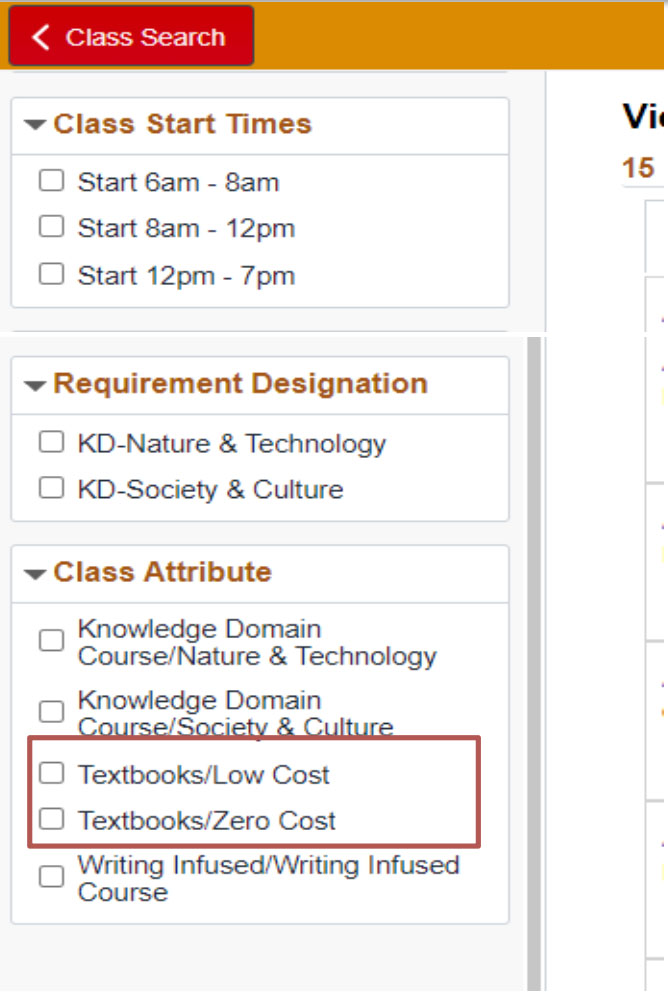
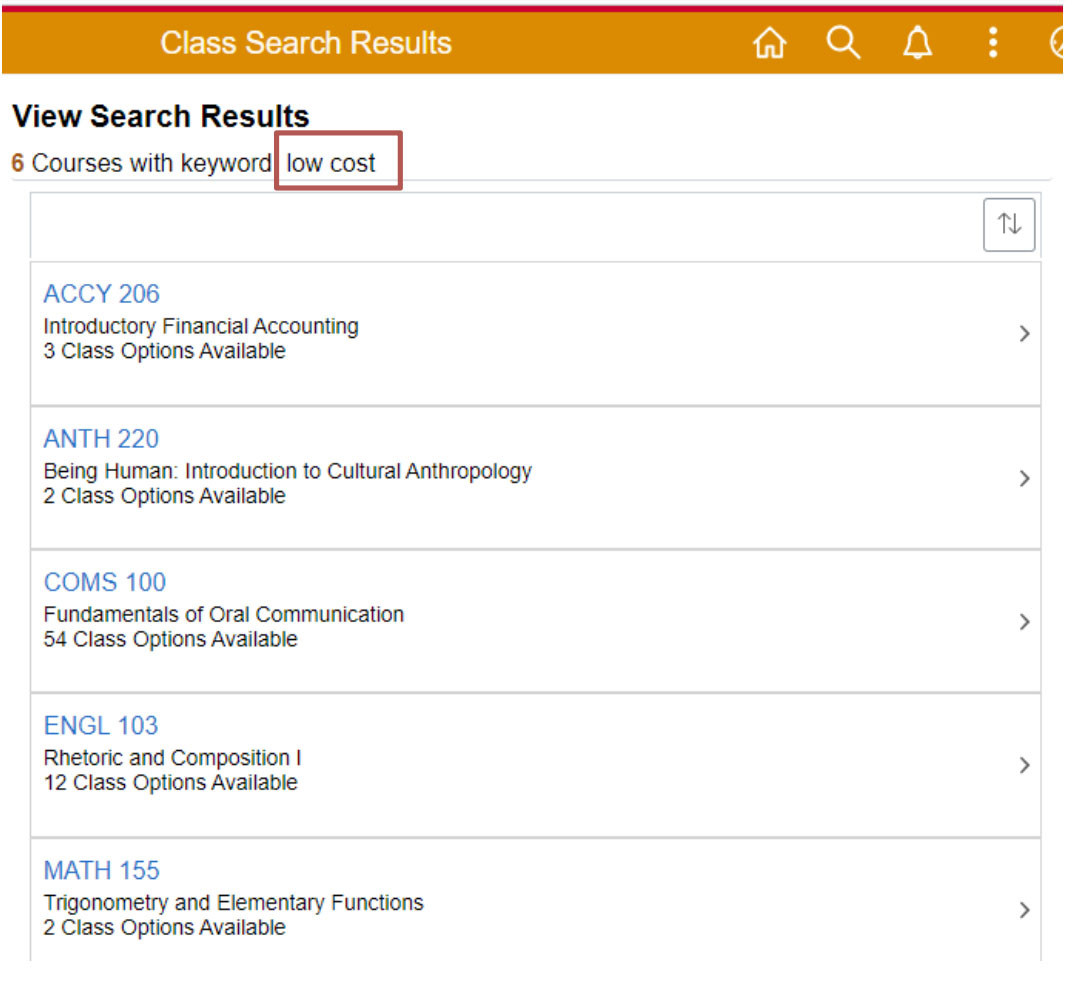
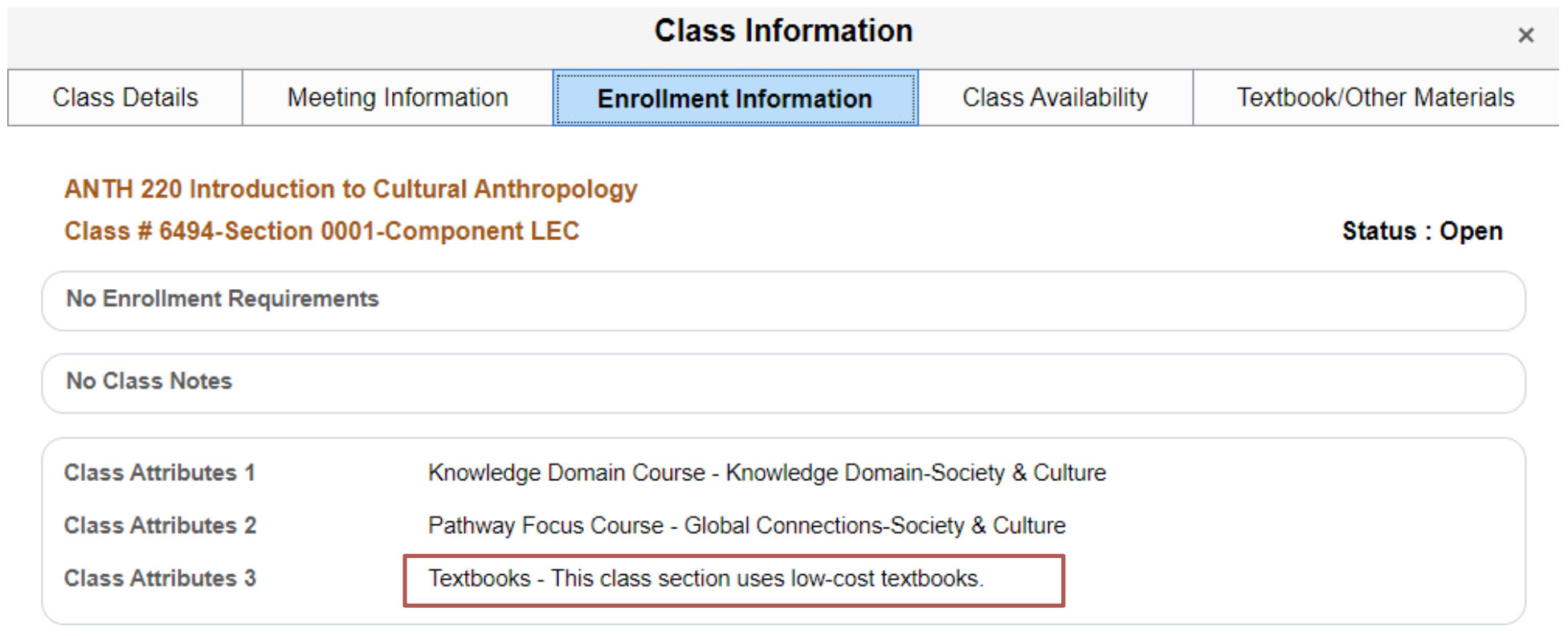
In MyNIU, students can apply a filter to class searches, or can search by keyword to see all eligible classes.
Filter by Class Attribute Example
Search by Keyword Example
View in Class Details Example
From an equity perspective, as many students rely on using their financial aid to purchase textbooks from the NIU bookstore and there isn't a guarantee moving forward that used copies of the textbook would be available for all students, this specific course wouldn't qualify for the low cost course designation.
Generally, courses with 5 students or fewer enrolled are not counted toward department ACM courses. Therefore, designating these courses as low or zero cost is optional. Independent study courses often require reading multiple books which may not be available through the library. While dissertation hours do not require a textbook, students still need access to various materials that could incur costs. Labs are typically tied to another course that may require an expensive textbook or courseware. Practicums provide students with real-world or professional experience, so typically do not require textbooks.
If the ebook is available through the library AND has an unlimited simultaneous user license, then the course would qualify as low-cost or zero-cost. However, keep in mind that ebooks are subject to publisher's discretion, and they may decide to withdraw access from library collections with little or no notice.
If all materials for a course are available through library collections so that all students in the course have simultaneous access, then, yes, the course would qualify for the no-cost course designation. This would include articles available through library databases, ebooks with unlimited user access, or materials available through electronic reserves. However, required materials that are only available through the library’s print reserves would not qualify because these items are only available to one student at a time for two hours within the library.
If a few print copies are placed on reserve, or the library owns a single print copy that can be checked out, the course would not qualify for the designation because the materials are not available to all students at all times.
In the Follett form, we recommend keeping the Required field blank and putting in the Notes: "Instructor will provide links to materials." For students who may prefer a print version of the textbook (that they would have to purchase), you can put the textbook as recommended, not required, or optional.
Affordable Course Materials (ACM) Department Awards and Faculty Recognition
No, departments do not need to apply to be recognized. Percentages are determined by the number of departmental courses in MyNIU with low- or zero-cost course attributes and the total number of courses offered by the department. Therefore, departments should ensure that course schedulers are designating relevant courses as low-cost and/or zero-cost course materials courses.
Faculty who have already adopted low- or zero-cost course materials can be recognized on our faculty recognition page. Faculty may also work with their scheduler to have their courses designated as low- or zero-cost courses in MyNIU. The designation for these courses allows students to search for low- or zero-cost courses.
One way to evaluate library resources as required course materials is to consider their stability of access and affordability for students. Open Educational Resources are considered to have very stable access and affordability, while Textbooks (print or electronic) may have very stable access, if purchased outright but are often not affordable. Here are how the university librarians rate library resources.
Library ebooks (with unlimited user licenses) have somewhat stable access and are very affordable; students do not have to pay any additional fees to use them, but libraries never truly own electronic resources, so there is the possibility of a publisher removing access.
Library articles (via databases) have somewhat stable access and are very affordable; students have access for free so long as the library continues to subscribe to that journal and/or database.
Library e-Reserves have stable access and are very affordable; students pay nothing to access resources legally scanned and uploaded to Blackboard by library staff.
Library Print Reserves have limited stable access and are somewhat affordable; a single physical copy available at the checkout desk requires students to access materials in-person and wait for their classmates to finish using it before they can check it out.
Contact Us
Center for Innovative Teaching and LearningPhone: 815-753-0595
Email: citl@niu.edu
Phone: 815-753-1995
Email: lib-admin@niu.edu