Faculty Spotlight: Helen Nagata
School of Art and Design
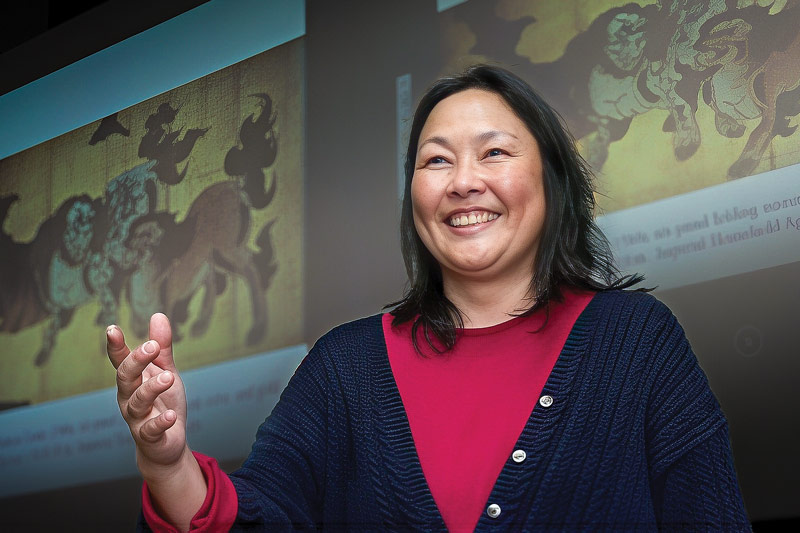 Bridging Cultures Through Art History
For Helen Nagata, the path to art history was clear from an early age. Born in California and raised in Tokyo from age 11, Nagata grew up bilingual and bicultural, naturally seeing herself as a bridge between cultures. This perspective helps to shape her academic journey and continues to influence her teaching and research at Northern Illinois University.
Following her passion for art and literature, Nagata majored in studio art and English literature. It was during her first Asian art history class her sophomore year that everything clicked. She realized how deeply connected she was to the material — recognizing artists’ names, artworks and cultural references she had known but never formally studied. Her love for analysis, interpretation and cultural connection solidified her path in art history. She added art history for a triple major and prepared for graduate studies by completing intensive language classes, traveling through Europe and interning in the East Asian Conservation Studio at the Metropolitan Museum of Art in New York. On her journey toward her Ph.D. at Stanford, she served as curator of Asian and Ethnographic Art at the Rhode Island School of Design, and studied at Gakushūin University in Tokyo.
Today, Nagata continues to bridge cultures in her teaching, particularly through an ongoing collaboration with Yamaguchi Prefectural University in Japan. In her Asian American Art course, NIU students work with students in Japan to explore artists and movements they might not otherwise encounter. Through virtual meetings and group projects, this collaboration fosters cross-cultural exchange, helping students on both sides deepen their understanding of art and its historical contexts.
Cultural Heritage and Art Historical Methodology
Nagata’s scholarship is informed by both Japanese and Western art historical traditions. While Japanese scholars emphasize meticulous data collection and institutional history, Western methodologies often encourage broader theoretical debates. Nagata values both approaches but is particularly drawn to the interpretation of objects within their cultural contexts. She strives to bring artworks to life for her students, emphasizing how form, function and audience engagement shape meaning.
Her research focuses on Edo period (17th to 19th century) art, particularly the dialogue between past and present in traditional and modern woodblock printing. She is fascinated by the intersection of art and text, often studying illustrated books and their intricate narratives. For Nagata, understanding the layers of meaning within an artwork — like decoding poetry — is a magical and rewarding process.
Fostering Critical Thinking in the Classroom
Nagata’s teaching philosophy centers on developing students’ analytical and interpretive skills. She encourages students to go beyond simply reporting research findings and, instead, engaging deeply with visual observation, analysis and interpretation. Whether in introductory or advanced courses, she helps students build confidence in their ability to analyze, research and discuss art with clarity and insights.
Recognizing the challenges students face in balancing their academic and personal lives in what can be a worrisome, confusing world, Nagata also emphasizes well-being. She often shares insights from Aikido, especially the fact that the first thing one learns is knowing how to fall and roll as an important part of training learning process — a metaphor for resilience, adaptability and knowing how to rebound. By fostering a supportive learning environment, she hopes to instill not only intellectual curiosity but also the emotional flexibility necessary for success.
Advice for Students
For students navigating art history, cultural studies and contemporary discourse, Nagata advises a critical yet open-minded approach. She reminds students that scholarly perspectives evolve over time and that learning is an ongoing, living process; thus, she encourages students to engage in it with joy, curiosity and a willingness to collaborate.
Above all, Nagata believes in the power of community. Whether through classroom discussions, collaborative research or international exchanges, she sees learning as a shared journey — one that enriches both students and educators alike.
By Courtney Tran
Contact Us
Jui-Ching Wang
Coordinator
Helen Nagata
Co-Coordinator
Kacee Dugas
Graduate Assistant
Janine Salapantan
Graduate Assistant
Office Hours
Tuesdays and Thursdays
11 a.m.-noon, located at the Asian American Resource Center