Campus Ally: Aurore Candier
Center for Burma Studies
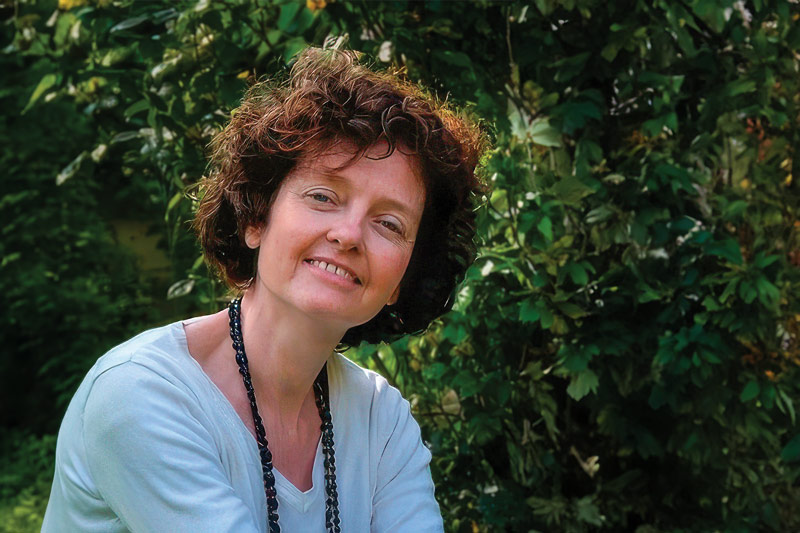 Aurore Candier is one of the most prominent figures in the Center for Burma Studies at Northern Illinois University. With the goal to foster a rich academic and cultural community, Candier — a French historian and researcher, and the center’s new director since January 2024 — has worked diligently to build the center into a dynamic space by carrying out projects dealing with complex global issues.
Looking back at her roots, Candier has been inspired by her travels and family’s interest in Southeast Asia. While the majority of French historians study previous French colonies such as Laos, Vietnam and Cambodia, Candier decided to explore a less-chartered academic territory by specializing in Burma studies during the mid-1990s. She started to study the Burmese language at Institut National des Langues et Civilisations Orientales (INALCO), one of the top universities in the teaching and learning of multiple languages and civilizations.
“Burma studies, to me, means to engage with any topic related to Burma or Myanmar … the land, the history and culture. I think the main point is the mastery of the language to be able to engage with Burma studies. I’m only able to speak Burmese [the official language in Burma], so I’d really like to learn Shan or Karen, but not yet,” said Candier.
As the director of the Center for Burma Studies, Candier aims to bring together different generations of scholars and students from the Burmese diaspora in Europe, Asia and North America. Although global political situations and uncertainties create unique challenges in her work, these challenges motivate her to further push the Center’s mission.
“The field of Burma studies itself has changed a lot throughout the last 20 years. In the 2010s, students and scholars could go to Burma [Myanmar] and do fieldwork research in a more open way. Myanmar students and scholars could easily get scholarships to study abroad and participate in global education programs,” said Candier.
NIU has collaborated with Burmese universities and institutions for exchange programs and study abroad programs since 2010. However, the recent political turmoil in Burma has drastically affected the access to these programs and immersive research in the country. It has also created a division within the Burma studies community, with some scholars focusing on advocacy and others prioritizing continued research.
“After the recent military coup in 2021, the country closed again, and scholars who couldn’t really go to Burma anymore refocused their research interest on advocacy against the military. Others just want to continue [their] research interests. The challenge [now] is to bring them together, and that’s what I like about being the director,” Candier said.
When one door closes, another one opens. The situation in Burma led to international students coming to study at NIU after the coup. It also promoted collaboration with the Center for Southeast Asian Studies (CSEAS), as students began to explore different academic courses and exchange programs, especially with Chiang Mai in Thailand.
When asked about the relationship of Burma studies and Asian American studies, Candier highlighted the connection of the two in terms of large diasporas of refugees. The U.S. is home to a large Burmese population of refugees who were forcibly displaced due to racial or religious discrimination. There has also been a growing number of Burmese American students not only at NIU but also in other regions of the U.S. and Canada as well.
“We have now the Burmese American students who are generally the second or third generation of these diasporas. I met some Chin-American, and Karen-American students who are here at NIU from Rockford. I think it’s important for the Center for Burma Studies and CSEAS to create a basis for exchange and dialogue with Asian American students and international students,” Candier said.
Candier encourages students to be involved with the Center for Burma Studies and support their projects and events in partnership with CSEAS, Burmese Student Association and Southeast Asia Club, as she expressed, “All students are super welcome to visit us here at Pottenger House. Students can really engage with these associations with a very dynamic student body. The Center for Burma Studies’ main mission is to preserve and promote our large Burma art collection stored in Founders [Memorial Library]. So come and visit us. We don’t have a permanent exhibit place, but we’re happy to [show] tools of the collection especially for the students.”
Candier also invites students to enroll in the Burmese language program, headed by Tharaphi Than, or to enroll in her class, History of Buddhism in Southeast Asia, for spring 2026. She also mentioned the Journal of Burma Studies that is published twice a year. Exciting events of the center include the cosponsored lectures with CSEAS every Friday; the 16th International Burma Studies Conference that were held Oct. 10 to 12, 2025; and the exhibition developed in conjunction with the conference at the NIU Art Museum.
“Come visit our exhibition ‘Legacies on Display: The Forbidden and Venerated Arts of Burma’ at the NIU Art Museum. We are also working with Karen undergraduate students in gathering stories from refugees and from the Karen diaspora to use for a traveling exhibition. We [will] also use these stories to develop teaching materials to enhance the K-12 Southeast Asian American history curriculum in Illinois,” Candier said.
Candier has also initiated the One People One Flag Project with a Karen American undergraduate student with the aim to display and showcase the different ethnic groups in Burma. The Center for Burma Studies stands as a testament to the power of academic pursuits to bridge cultures, foster understanding and navigate a complex world.
“I like to encourage Burmese American students to come and bring their people’s flag. We are inclusive of all ethnic groups, religions and cultures of people whose identity and ancestry are associated with Burma and with the borderlands. Help us bring representation and diversity. Come and bring your flag, and we will display them,” Candier said.
Learn more about the Center for Burma Studies. Visit their conference and exhibit site for information on past, current and upcoming events.
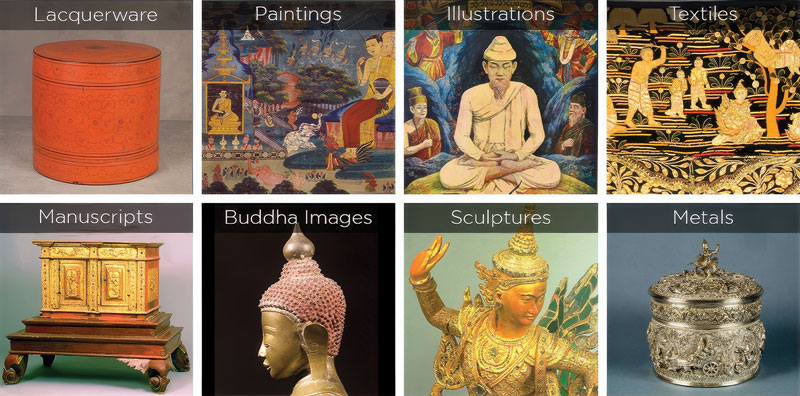
Visit the Burma Art Collection Online Database.
By Christian Paolo Eslava
Contact Us
Jui-Ching Wang
Coordinator
Helen Nagata
Co-Coordinator
Kacee Dugas
Graduate Assistant
Janine Salapantan
Graduate Assistant
Office Hours
Tuesdays and Thursdays
11 a.m.-noon, located at the Asian American Resource Center