The Project
The remote laboratory involves controlling physical (real) laboratory equipment remotely. This platform allows students to proceed at their own pace with greater flexibility. It features embedded assessments and a monitoring facility to track the progress of individual students and the class as a whole. The environment is customizable with a variety of laboratory courses, enabling STEM faculty to integrate their courses with minimal effort. Using this environment will make learning more engaging and effective in achieving students’ learning objectives. It also fosters self-monitoring and reflection skills while building on students’ pre-existing knowledge.
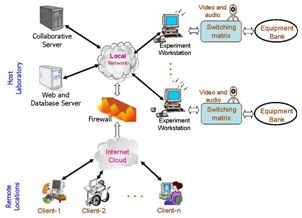
Remote Laboratory Features
The system is realized by integrating emerging internet technology, software, computer interfacing, a cutting-edge graphical user interface, effective pedagogical designs, and assessment and evaluation schemes. The developed environment has five major features:
- Learning through a remote laboratory.
- Easy integration with a range of STEM courses.
- Real-time video and audio link with experiments.
- Frequent student feedback.
- Faculty/facilitator monitoring of student progress and activities.
The system implementation involves:
- Designing and developing a remote laboratory facility.
- Designing and developing a graphical user interface for faculty/facilitators.
- Designing and developing laboratory modules.
- Utilizing the environment to offer target laboratory courses.
Provisions are made to gather extensive data, which are analyzed to evaluate the system's effectiveness, project implementation details, achievement of student learning outcomes, and students' learning behavior. The evaluation process involves students, faculty, and program industrial advisory board members. Most of the data are collected through the environment's built-in software-based features.
Contact
Abul K.M. Azad, Ph.D.Department of Engineering Technology
815-753-0386
aazad@niu.edu
Faculty website